When Should a Tree Be Removed? The Ultimate Tree Removal Guide
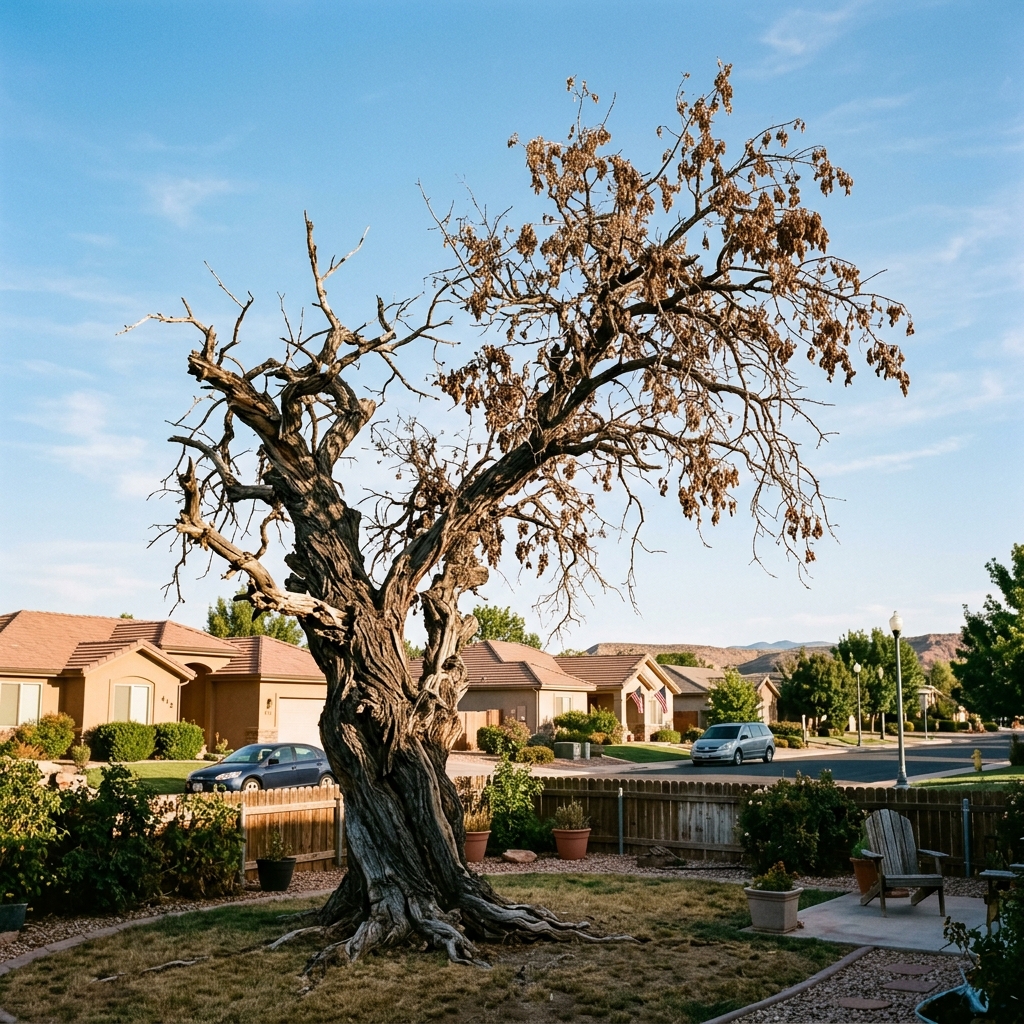
There are good reasons a tree that was once an asset to your property may need to be replaced. While no one wants to remove a tree, some trees have shorter lifespans due to drought or other conditions. It can be difficult to measure whether the cost of supporting the tree outweighs the cost to remove the tree, and that’s why we created a list of the 4 most honest reasons for tree removal in St. George, to help you find the answers you need.
Is Your Tree Dead?
Just because a tree is dead does not mean it cannot stand for years before it finally falls. This poses a risk to public safety because dead trees can become unstable and cause damage during a storm.
Here are a few signs to look for:
- No leaf growth in the active season
- Branches that have become brittle and snap
- Sections of bark are missing with no green layer, and large peelings
- Growth of fungus at the base or on the tree
The Arbor Day Foundation says it is appropriate to remove a tree if 50% or more of its branches are dead.
Is Your Tree Dying?
Dying trees can be more challenging to identify. These trees can still have some leaves, but their integrity is compromised. Dying trees can be noticeably different and can even start to break. Others can become more dangerous and unpredictable. Look for these signs:
- Sparse leaves or even discolored leaves
- Hollow or soft spots in the trunk
- Dieback in the upper sections of the tree
- Epicormic growth
The University of Maryland Extension suggests that if more than a third of a tree’s trunk is hollowed or rotted, the tree should be removed. For St. George homeowners, you should think of these signs seriously. The desert heat speeds decay in already weakened trees.
Does Your Tree Pose a Risk?
Some trees may appear to be in good condition, but may pose a serious risk. Here are a few good examples of risk:
- Dangerous Lean — A tree that has a lean greater than 15 degrees from vertical after a bad storm is in immediate need of assessment.
- Large Dead Branches — These can fall unexpectedly on calm days, and are often called “widow makers”.
- Trunk Cracks or Splits — Internally, these trees are failing and can be caused by vertical deep cracks.
- Heaving Soil or Root Damage — A tree can be seriously compromised if up to 50% of the root system is damaged.
These are all strong examples of the need for immediate professional tree removal services in St. George.
Is Your Tree in the Wrong Spot?
Sometimes, a healthy tree is still in the wrong spot. A tree is considered to be in the wrong spot when it:
- Is growing into or near powerlines.
- Is within 20 feet of a home’s foundation.
- Is growing roots that are damaging pavement or underground utilities.
- It is an invasive tree species that is aggressively growing and damaging the surrounding ecosystem.
Poor placement of trees is the most common reason for tree removal in St. George, especially as a landscape matures and trees grow out of their planting region.
The Bottom Line
If your tree fits any of these requirements, do not wait for a storm to bring it down. Tree removal in St. George should be handled by an experienced, certified arborist. They can evaluate the situation fully and safely complete the job.
While not all struggling trees should be removed, many that should be removed need to be removed quickly. Make sure to document everything and schedule an appointment so an experienced arborist can assess the need for prompt removal.

Choose Pest Control Park City after Getting Right Answers

Eco-friendly Benefits of Sustainable Shades in Park City

A Step-by-Step Guide to Kitchen Remodeling in Park City
About Author
